Will the Project-Affected People’s Mechanism Finally Accept Cases in 2026?
.jpg)
As the Board of Governors of the Asian Infrastructure Investment Bank gathers for its 11th Annual Meeting in Doha, Qatar, there is an important question on our minds—will 2026 be the year that AIIB’s Project-affected People’s Mechanism finally accepts cases?
AIIB’s investments have long been associated with serious environmental and social (E&S) harm and human rights violations in Indonesia, Bangladesh, India, and elsewhere, leading to questions and concerns from various quarters including the UN, civil society organizations monitoring projects, affected communities, and even former employees.
A former AIIB official was anonymously quoted by Devex in a piece marking AIIB’s first 10 years, “There hasn’t been a major scandal yet emerging from AIIB projects, but my analysis is that the risk of one coming out, and soon — in the next three to five years — is quite high because of the way that the bank carries out its environmental and social due diligence.”
Yet, its institutional independent accountability channel, the Project-affected People’s Mechanism, is yet to investigate a single complaint since its inception in 2018. And despite the well reported concerns about AIIB’s activities, its ‘Learning and Evaluation Unit’ has evaluated 4 projects thus far and has found all four projects to be successful (or highly successful) and AIIB’s work quality to be satisfactory. In this article, we examine this disconnect between the external perception and evidence of AIIB’s weak E&S record and the Bank’s inability and seeming unwillingness to take cognisance of such harm and be part of the remedial action.
Affected-communities have lost trust in the mechanism and the institution
With 43 ineligible complaints (as of September 15, 2026) and several instances of AIIB’s management denying AIIB’s responsibility in harms associated with its investments it would not be surprising if affected-communities hesitate to put their faith in the institution (either AIIB management or the PPM) to hear their grievances and resolve their concerns. Communities have limited resources when advocating for their interests in the face of large scale infrastructure projects and if a complaint to the PPM is more than likely to be ineligible, they may determine their time and effort is better utilized by creating public campaigns or engaging with the UN. When communities feel that they cannot approach AIIB, the institution loses out on the opportunity to constructively engage to address harms that undermine sustainability and AIIB’s mission.
The 2024-2025 PPM Policy review process was another opportunity to address the many issues that led to findings of ineligibility, but the Bank retained the PPM’s most exclusionary policies thus continuing to subscribe to a hands off approach to accountability and remedy.
Continued limitations in the PPMs visibility and accessibility
Since the adoption of the new policy in 2026, the PPM has received 16 complaints of which 14 have been found ineligible:
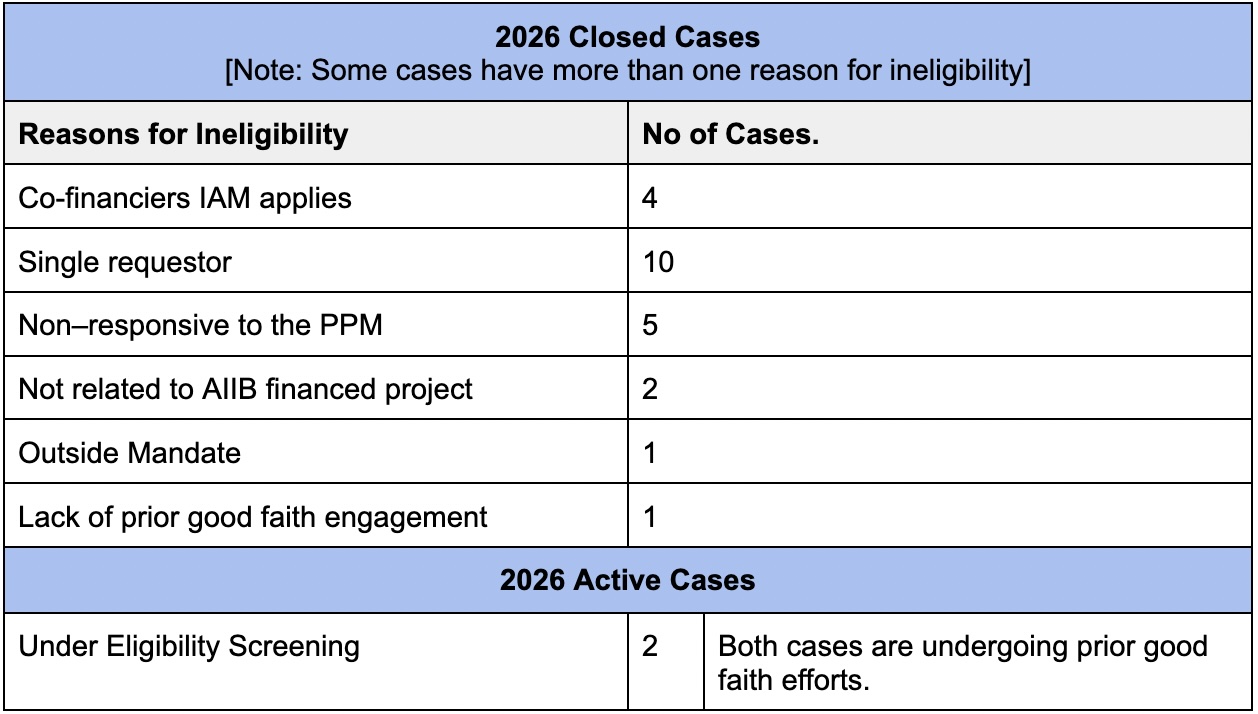
- Co-finance exclusions still prevent AIIB from being part of the solution for the harms caused by their financing:
AIIB has long followed an approach to co-financing projects where it delegates its environmental and social obligations to the co-financier and absolves itself of facilitating remedy. There are now 80 complaints filed to IAMs of co-financiers, where AIIB has contributed hundreds of millions of dollars. As of the 2026 PPM Policy, if a co-financer’s IAM makes a finding of non-compliance, management will report to the Board on the implications for AIIB and the opportunities for institutional learning resulting from that IAM’s findings. To our knowledge, this power has yet to be exercised.
- A significant number of requestors are excluded because they are single requestors and many are non-responsive to PPM’s follow ups:
Of the 16 complaints received by the PPM in 2026, 10 were filed by single requestors (and 28 out of 45 total complaints). The PPM policy requires complaints to be filed by two or more requestors, so these complaints are found ineligible. Many of these requestors are filing individual complaints from the same projects. Two projects in particular, Sylhet to Tamabil Road Upgrade Project in Bangladesh and Kochi Metro Rail Project - Phase II in India have resulted in 8 and 4 single requestor complaints respectively (between 2026 and 2025). There could be a few explanations for this:
- Affected-communities only find out about the PPM and its basic rules if project implementors are sharing adequate information about these channels at project sites. If this information is not shared in a clear and accessible manner, affected-communities are likely to remain unaware or be denied access for failing to meet eligibility rules. According to the 2024 External Review Report on the PPM, “[a]n internal AIIB analysis of GRMs found that there was limited information available on actions undertaken to raise awareness of project level GRMs and the PPM.” During the review of the PPM Policy, AIIB management committed to improving the information dissemination of PPM. The PPM should both monitor the implementation of these commitments and understand from requestors whether they are made aware of this requirement for two or more complainants to file at project sites.
- Filing a complaint jointly also requires impacted households to organize with other similarly impacted households. But there can be barriers to organising within a community, particularly in contexts of restricted civic space. As a result, many single requestors are raising the same issue and facing ineligibility. The PPM can play an important role in conducting proactive outreach to the complainants prior to deeming the case ineligible to explain the eligibility barrier and working with the complainants to amend the complaints and overcome the eligibility hurdle, including through offering to combine these individual cases as it has done in a recent complaint from Pakistan that was nonetheless found ineligible because of the co-finance exclusion.
- Many of these single requestors complaints are also not responding to the PPM on follow ups. The PPM should explore the underlying reasons for this and identify ways to improve community responsiveness.
- Two cases are undergoing prior good faith efforts with project implementation units.
In order to file a complaint with the PPM, affected communities are required to engage with borrowers and Bank Management. The 2026 PPM Policy expanded exceptions to this rule and limited the required prior engagement with management to a 45-day time period. We hoped this would prevent a situation where communities spend months and years trying to resolve their concerns before being able to access the PPM. There are currently two cases (both filed in May 2026) that are undergoing this process. We will continue monitoring the outcomes of these processes. The case registry also notes other instances of issues getting resolved outside of the process but there is no transparency on these cases.
How can AIIB/PPM overcome these challenges?
Our demand isn’t for AIIB to accept one case, although that would be a welcome start. Our demand is for the Bank to no longer subscribe to the view that providing millions of dollars in financing to a project does not mean having a corresponding duty to prevent and remediate E&S harm, whether the project is funded through co-financiers, financial intermediaries, or capital markets.
Large scale infrastructure projects carry environmental and social risks and have been associated with human rights violations for decades. Institutions like AIIB have a corresponding duty to use existing tools like independent accountability channels to hear directly from project-affected communities and resolve their concerns. If not, AIIB risks protracted conflict, stranded assets, and reputational harm. If AIIB continues following an approach where it wilfully avoid engaging in remediation, it risks not only individual investments but its legacy as a responsible investor.
Subscribe to our newsletter.
Sign up for periodic updates on our work alongside communities, defending rights and demanding justice.